

Rui'an Huadu Intelligent Machinery Equipment Co., Ltd. started in 2013 and is located on the coast of the East China Sea, in the "Packaging Machinery City" - Wenzhou City. It is a modern scientific and technological enterprise integrating R&D, production, economy and trade. It has passed CE certification, IS09001 quality system certification, and obtained a number of patents. Engaged in carton packaging equipment for more than 10 years, with advanced technical force and production technology, rich manufacturing experience, reliable product quality, reasonable price, can provide customers with equipment, technology, raw material supply all-round services, help customers create professional, intelligent Industrialized and unmanned Industry 4.0 factories.


Why Choose Us
Our Factory
Our company has more than 50 authoritative certificates, 3400m² plant area, more than 10 years of industry experience, and annual sales of 50 million.
High-quality Technology
We carefully select high-quality electronic components from suppliers all over the world, including PLC, touch screen brands and electronic components, Siemens, sensor suppliers, SICK and servo motors.
Exquisite Workmanship
We can provide quality workmanship to meet the various needs of customers around the world. At the same time, it also provides machine after-sales warranty. Our company has ISO certificate support, and the machines are all CE certificate certified.
R&D Capabilities
We have a strong R&D team, always maintain an innovative spirit, and support on-demand customization. We serve customers wholeheartedly and adhere to the strategy of combining industrial management with brand management.
Enhanced Efficiency and Speed: Packaging linkage production lines automate repetitive tasks like filling, sealing, and labeling, drastically reducing the time needed to package each item. This boosts overall production speed and enables businesses to meet high demand efficiently, without compromising on quality.
Improved Consistency and Quality Control: Packaging linkage production lines ensure a uniform process, resulting in consistent product quality and presentation. This consistency is crucial for maintaining brand reputation and meeting regulatory standards, particularly in industries like food, pharmaceuticals, and cosmetics.
Cost Savings: While the initial investment may be significant, a packaging line can reduce long-term labor costs by minimizing manual handling. Additionally, automation reduces waste and errors, leading to cost savings on materials and minimizing product loss.
Increased Flexibility: Modern packaging linkage production lines are often adaptable, allowing manufacturers to switch between different products or packaging formats. This flexibility enables companies to respond to changing consumer demands or market trends without overhauling their entire production system.
Scalability:
A well-designed packaging linkage production line allows manufacturers to scale up production without requiring significant changes or additional labor. This scalability is beneficial for growing businesses or those with seasonal product variations.
Better Workplace Safety:
By automating potentially hazardous tasks, packaging linkage production lines reduce the risk of workplace injuries associated with repetitive manual labor, heavy lifting, or working with packaging materials and machinery.
Enhanced Traceability and Data Tracking:
Many packaging linkage production lines are equipped with digital tracking and monitoring systems, enabling companies to track production in real-time. This data is valuable for managing inventory, forecasting demand, and maintaining traceability for compliance purposes.
The machines of special size can be customized as per the customer's requirements
|
Model |
RZB450 |
Model |
GD890 |
|
|
Film max-width |
450mm |
Cups diameter |
Φ60-Φ90mm |
|
|
Film thickness |
0.012-0.05mm |
Number of single counting |
1-100/pieces |
|
|
Packaging speed |
20-120 (bag/min) |
Counting speed |
1250 (pcs/min) |
|
|
Bag dimensions |
L |
200-600mm |
Count equipment(Choose) |
A: Screw type B: Fibre-optical type |
|
H |
≤90mm |
|||
|
Connection size |
6300*900*1500mm |
Way of delivery(Choose) |
A: One B: Two |
|
|
Power |
2.8kw |
Connection size |
6300*900*1500mm |
|
|
Weight |
1200kg |
Power |
2.8kg |
|
Feeding System: This system initiates the process by feeding products or raw materials onto the line. It can involve conveyors, hoppers, or feeders that direct items smoothly to the next stages.
Filling Machine: Essential for products that require packaging in specific quantities, the filling machine accurately dispenses liquids, powders, or solids into containers, bags, or boxes, ensuring precise measurements and reducing waste.
Capping and Sealing Machines: Once products are filled, capping and sealing machines secure the packaging, preserving product freshness and preventing contamination. These machines may use various sealing methods, such as heat sealing, screwing caps, or shrink wrapping.
Labeling and Coding Machine: Labeling machines apply labels or branding to packaging, while coding machines add important information, like expiration dates, batch numbers, or barcodes. These elements help with product identification, traceability, and compliance with regulations.

Inspection System:
This component includes sensors, cameras, and quality control mechanisms to ensure that each package meets quality standards. It detects issues like incorrect fill levels, damaged packaging, or missing labels.
Cartoning and Wrapping Machine:
These machines place filled products into cartons, boxes, or cases for easier handling and shipping. Wrapping machines may also shrink-wrap items or apply protective films to safeguard products during transport.
Conveyors:
Conveyors move products through each stage of the production line. They are designed to ensure smooth, efficient transport from feeding to packaging and final inspection, minimizing manual handling and keeping the process continuous.
Palletizing System:
For large-scale production lines, palletizers automate the stacking of packaged products onto pallets, preparing them for shipment. This step reduces labor and speeds up the packaging-to-distribution process.

Assessing Requirements: The first step in packaging linkage production line design is to assess the specific needs of the operation. This includes understanding the types of products, packaging materials, and production volumes. Detailed analysis helps in selecting the right equipment and layout.
Equipment Selection: Choosing the right equipment is critical. Factors to consider include the speed of operation, compatibility with different product sizes, and ease of maintenance.
Layout Planning: Efficient layout planning involves creating a logical flow of products. Using software tools for simulation can help in visualizing different layouts and identifying potential bottlenecks. The goal is to create a streamlined process that minimizes handling and maximizes throughput.
Integration of Automation: Automation can significantly enhance packing line efficiency. Integrating automated systems such as robotic arms for palletizing, automated guided vehicles (AGVs) for material transport, and sensors for quality control can lead to substantial improvements in productivity and accuracy.
Sustainability Considerations: Modern packing line design also incorporates sustainability practices. This includes using eco-friendly packaging materials, reducing energy consumption through efficient machinery, and minimizing waste through precise control systems.
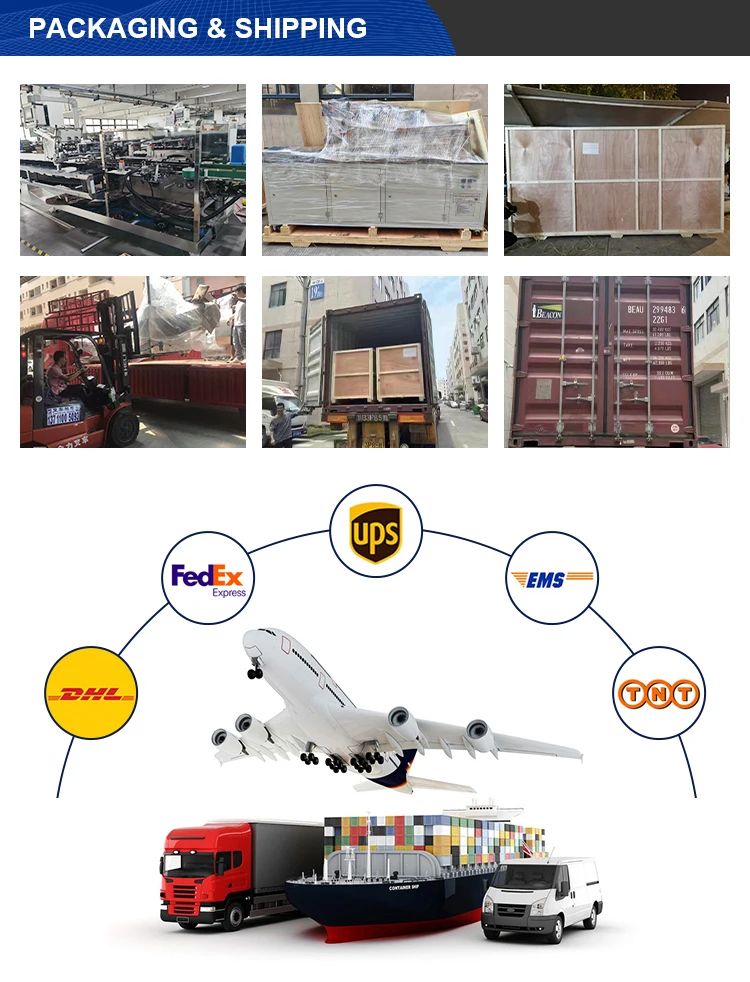
Packaging and Shipping
Our Certificates


FAQ
As one of the most professional packaging linkage production line manufacturers and suppliers in China, we're featured by quality products and competitive price. Please rest assured to buy packaging linkage production line for sale here from our factory. For customized service, contact us now.
Ball Automatic Feeder Packaging Production Line, Disposable Cup Packaging Linkage Production Line, Packaging Linkage Production Line